A Closing Disclosure is primarily a buyer-side mortgage document, but California sellers often hear the term during escrow and wonder whether they are supposed to review it. The practical answer is this: the buyer’s Closing Disclosure explains the buyer’s loan and closing costs, while the seller usually reviews a separate Seller’s Closing Statement or settlement statement prepared by escrow. This guide explains the difference, what seller charges mean, and how to review the numbers before closing.
What is a Closing Disclosure in real estate?
A Closing Disclosure, often called a CD, is a five-page lender form that gives final details about the mortgage loan the buyer selected, including loan terms, projected payments, closing costs, and the cash needed to close. In plain terms, the closing disclosure meaning is the buyer’s final loan and cost disclosure, not the seller’s full accounting of sale proceeds. The form is part of the TILA-RESPA Integrated Disclosure framework, commonly called TRID, which combines mortgage disclosure requirements under federal lending and settlement rules. (consumerfinance.gov)
That distinction matters for California sellers because the CD is tied to the buyer’s financing. It may show some seller-paid items, such as agreed credits or certain closing costs, but it is not designed to be the seller’s main document for verifying payoff amounts, commissions, escrow fees, prorations, and net proceeds. When people search for a closing disclosure statement, they may be using the phrase loosely, but in mortgage transactions the CD has a specific buyer-lender purpose.
The California seller usually reviews a different statement
California home sellers typically receive a Seller’s Closing Statement, seller settlement statement, Final Closing Statement, or similarly named document from escrow. The California Department of Real Estate notes that closing statements may be called Buyer’s Statements or Seller’s Statements in Northern California, while Southern California commonly uses names such as Final Closing Statement, Settlement Statement, or HUD-1. (dre.ca.gov)
This seller statement is distinct from the buyer’s Closing Disclosure. The buyer’s CD explains the buyer’s loan and closing obligations; the seller’s statement explains the sale-side money flow. It generally starts with the sales price, then subtracts seller debits such as loan payoffs and transaction expenses, adds seller credits when applicable, and arrives at estimated or final net proceeds. For the escrow process behind it, read what is escrow in real estate.
Think of the two documents this way:
| Document | Main user | Main purpose | What California sellers use it for |
|---|---|---|---|
| Buyer’s Closing Disclosure | Buyer and lender | Final mortgage loan and closing cost disclosure | Confirm seller credits or seller-paid items shown |
| Seller’s Closing Statement | Seller and escrow | Accounting of seller charges, credits, payoffs, and proceeds | Review the amounts and check net proceeds |
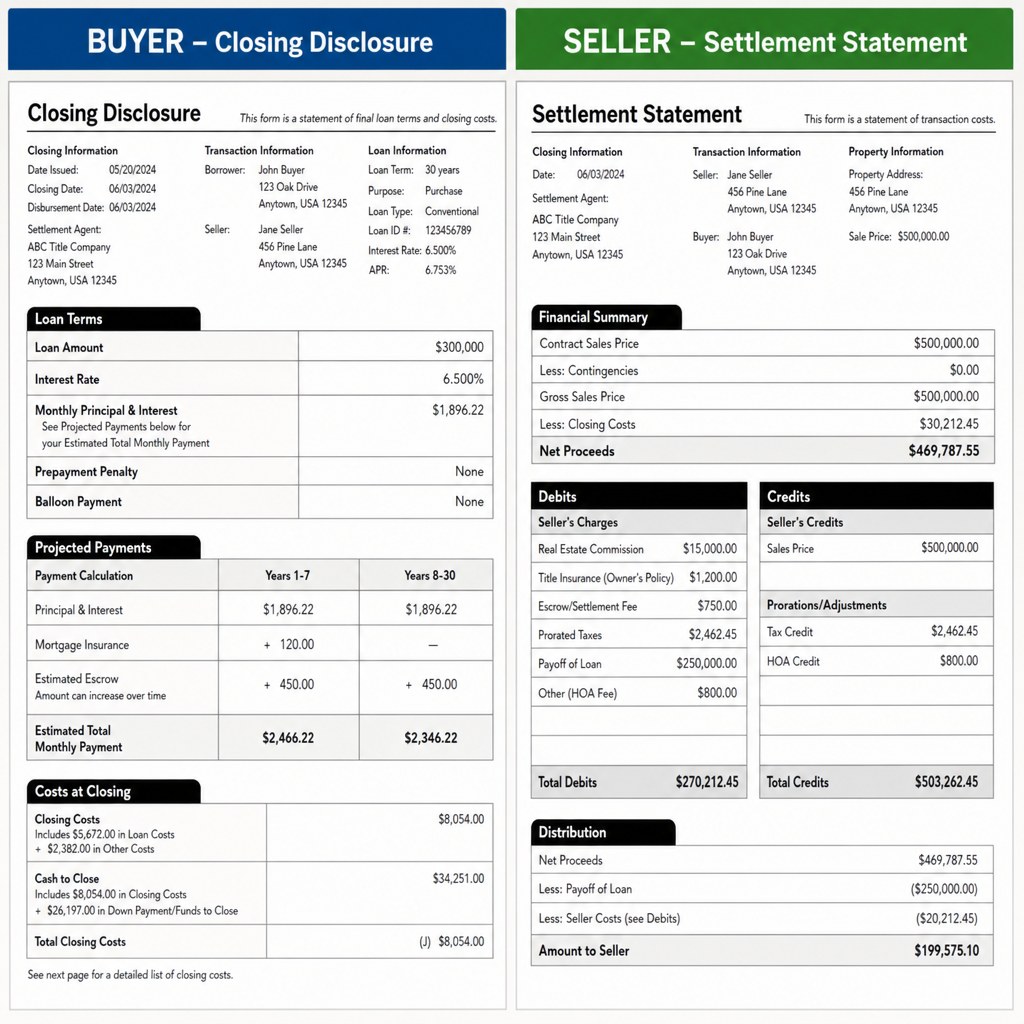
Seller-side charges on the settlement statement
The easiest way to read a seller statement is to separate the entries into sale price, deductions, credits, prorations, and final proceeds. Labels vary by escrow company, but the financial logic is usually consistent: debits reduce the seller’s proceeds, while credits increase them. You can preview many of these items with the seller net proceeds calculator.
Commissions
Real estate commissions appear as charges connected to brokerage compensation. Depending on the agreement and escrow format, they may be listed as separate amounts for each brokerage or as a combined commission line. Sellers should compare the percentage or flat amount shown with the signed listing agreement and any written changes made during the transaction. See real estate commission in California.
Transfer tax and recording-related charges
Transfer tax is a government charge connected to transferring real property. In California, the amount and allocation can depend on the location and the contract terms, so the seller statement should be checked against the escrow instructions and local practice. Recording-related items may also appear if certain documents must be recorded or released as part of closing.
Title fees
Title-related fees may include the owner’s title policy or other title services, depending on the transaction and regional custom. On the seller statement, these show who is paying for the title items assigned to the seller side. A seller should look for duplicate title entries, unexpected add-ons, or charges that do not match the escrow estimate.
Escrow fees
Escrow fees compensate the escrow holder for processing the closing, handling instructions, coordinating funds, and preparing settlement paperwork. In many California transactions, escrow fees may be split or allocated according to the purchase agreement and local custom. The seller statement should show the seller’s portion clearly, often as a separate line item.
Loan payoff amounts
If the seller has an existing mortgage, home equity loan, or other payoff item tied to the property, escrow typically obtains payoff information and lists the payoff as a seller debit. This line can include the remaining principal, interest through a payoff date, and possible lender fees. Because payoff figures can change by day, sellers should pay attention to the payoff date and whether any mortgage payment was made shortly before closing. See selling a house with a mortgage.
Prorations
Prorations divide ongoing property expenses between buyer and seller based on the closing date. Common examples include property taxes, homeowners association dues, or other recurring charges. A proration may be a seller debit or credit depending on whether the seller has prepaid an item or owes for a period of ownership that has not yet been paid. Our guide on when property taxes are due in California explains the tax side.
Credits
Credits are amounts one party gives to another through closing. A seller credit might be negotiated for buyer closing costs, repairs, rate buydown costs, or another agreed item. On the seller statement, a seller credit usually reduces net proceeds, so sellers should match each credit to the purchase agreement, repair addendum, or other written escrow instruction.
What is an aggregate adjustment on a Closing Disclosure?
An aggregate adjustment is a line on the buyer’s Closing Disclosure related to the buyer’s escrow or impound account for items such as taxes and insurance. It is used in the buyer’s loan disclosure calculations and is not usually a seller-side charge on the Seller’s Closing Statement. If a California seller sees the term while reviewing the buyer’s CD or a combined closing package, the key point is that it belongs to the buyer’s lender-controlled escrow account analysis, not the seller’s net proceeds calculation.
This is a common source of confusion because the word escrow can refer to both the California escrow closing process and the buyer’s mortgage impound account. In the seller statement, the more relevant items are property tax prorations, HOA prorations, payoff charges, seller credits, and escrow company fees. If a line is unclear, ask escrow to identify whether it affects the seller’s proceeds and which instruction or document supports it.
What California sellers should verify before closing
Before signing final documents, sellers can review the settlement statement as a math and document-matching exercise. The California Escrow Association recommends reviewing the closing statement to determine whether costs were allocated according to escrow instructions. (ceaescrow.org)
Use this checklist to focus the review:
- Seller name and property address: Confirm names, vesting details, and the property address are correct.
- Sales price: Match the price to the accepted purchase agreement and any later amendments.
- Deposits and credits: Check that buyer deposits, seller credits, repair credits, and agreed concessions appear correctly.
- Commission amounts: Compare commission lines with signed brokerage agreements and any negotiated changes.
- Payoff figures: Review lender names, loan numbers when shown, payoff dates, and payoff totals.
- Escrow and title fees: Confirm the seller’s assigned charges are not duplicated or placed on the wrong side.
- Transfer taxes and local charges: Check that the allocation matches the contract and escrow instructions.
- Prorations: Review the date range used for taxes, HOA dues, rents if applicable, or other recurring items.
- Estimated versus final status: Notice whether the statement is marked estimated, preliminary, final, or amended.
- Net proceeds: Recalculate the broad math: sales price minus seller debits plus seller credits should support the final proceeds shown.
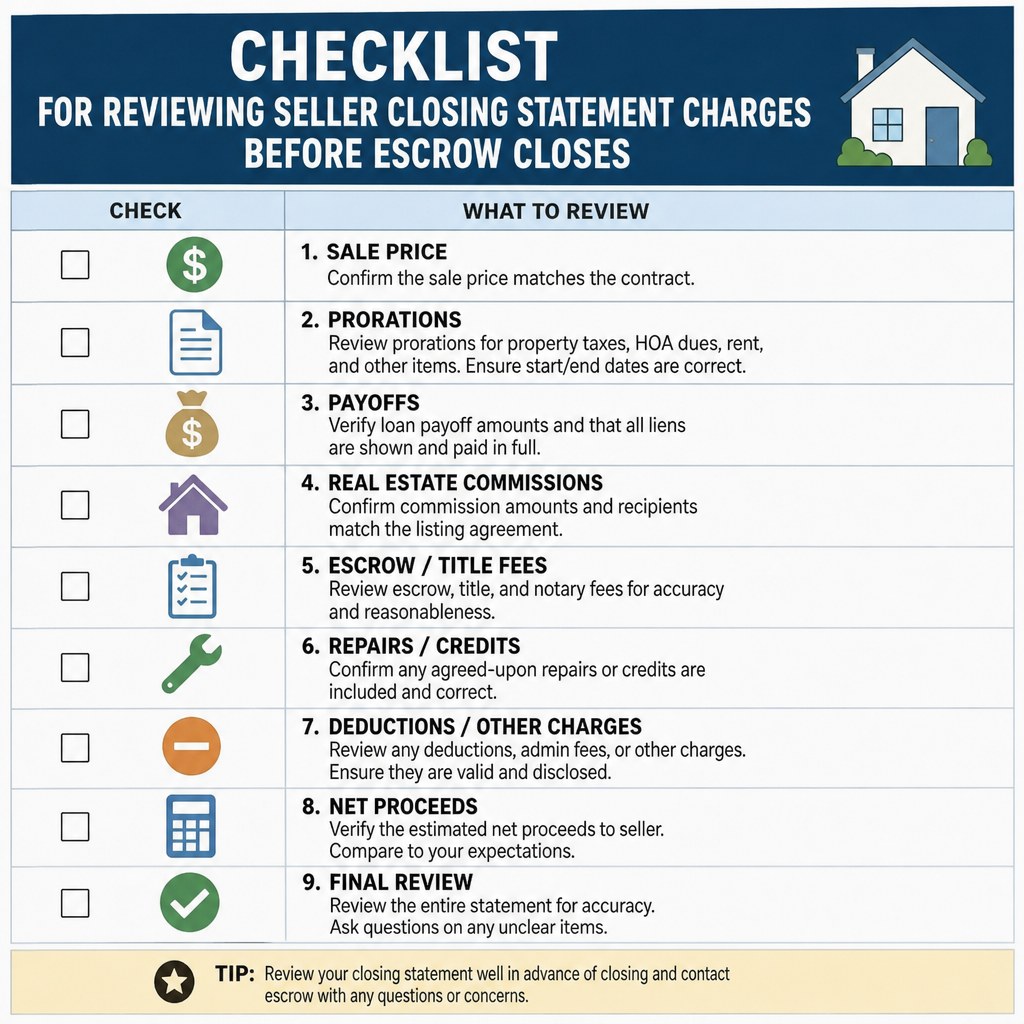
Common errors sellers may spot
Settlement statements are detailed, and small line-item issues can affect the final proceeds. Many errors are simple input or timing problems rather than major disputes, but they are still worth catching early.
Common issues include:
- Outdated payoff amounts. A mortgage payment made close to closing may not be reflected yet, or the payoff interest date may need updating.
- Duplicate fees. A title, escrow, HOA, courier, wire, or recording item may appear twice under similar labels.
- Missing credits. A negotiated repair credit or buyer-paid item may not appear if escrow has not received the instruction.
- Incorrect prorations. Property tax, HOA, or rent prorations may use the wrong closing date or billing period.
- Misallocated charges. A fee intended for the buyer side may appear as a seller debit, or a shared fee may not be split as expected.
- Name or address mistakes. Basic errors can slow document review or create confusion in disbursement paperwork.
A practical way to identify errors is to compare the seller statement against three documents: the purchase agreement, escrow instructions, and most recent payoff or HOA information. Read every debit as a question: what is this charge, who authorized it, and does the amount match the supporting document? Then review the final net proceeds separately so the bottom line is not hiding a line-item mistake.
Want an estimate of your net proceeds before you list?
Get a free home value estimate and a clear view of what you could net after commissions, escrow, title, and payoffs. No obligation.
Free. No obligation to sell.
When sellers typically receive the statement
In California, sellers often see an estimated seller statement earlier in escrow and a more final version near the end of the closing process. Timing varies by escrow holder, lender readiness, payoff availability, and whether last-minute credits or repairs are added. A final or near-final seller statement commonly becomes available once escrow has the key closing figures, including loan payoff demands, title charges, escrow fees, prorations, and buyer-side closing instructions.
Because numbers can change close to signing, sellers should treat early versions as estimates unless the document is clearly marked final. Payoff interest, property tax prorations, HOA charges, and credits can shift when the actual closing date changes. If the transaction is delayed, ask for an updated version before relying on the net proceeds figure. For general cost expectations, see average closing costs in California and who pays closing costs in California.
A clear way to read the closing package
The best approach is to keep the buyer’s Closing Disclosure and the seller’s settlement statement in their proper lanes. The CD is the buyer’s five-page loan disclosure under TILA-RESPA rules; the seller statement is the California seller’s accounting of sale proceeds, charges, credits, prorations, and payoff amounts. (consumerfinance.gov)
For a seller, the most useful question is not only what a closing disclosure is, but which document controls my side of the money. In most California home sales, that document is the Seller’s Closing Statement from escrow. Read it slowly, match each charge to the transaction documents, confirm the math, and request clarification on any unfamiliar line before closing documents are finalized.
Keep reading: What is escrow · Average closing costs in California · Seller closing costs · How selling with Sell For Mor works
This article is general information, not legal advice. Document names and practices vary by escrow company and region. Sell For Mor is powered by Rise Realty, DRE #01957687.