California property taxes follow a predictable annual calendar, but the details matter: the state uses two installments, separate due and delinquent dates, and county tax collectors handle billing and payment. For homeowners and sellers, knowing the calendar helps prevent 10% penalties, avoid title problems, and understand how taxes are divided in escrow. Always verify exact property tax dates, amounts, accepted payment methods, and any added charges with the county tax collector for the property. The California State Board of Equalization publishes statewide property tax information.
When are property taxes due in California?
Property taxes due in California are generally split into two installments for the annual secured property tax bill. The first installment is due November 1 and becomes delinquent after December 10; the second installment is due February 1 and becomes delinquent after April 10. If December 10 or April 10 falls on a Saturday, Sunday, or legal holiday, the delinquency deadline typically moves to the next business day, so check the county’s posted calendar before relying on a date.
California property taxes are billed for a fiscal year that runs from July 1 through June 30. That means a bill issued in the fall usually covers the tax year that began the previous July 1 and ends the following June 30. This is one reason sellers often see prorations at closing: the property tax year does not necessarily line up with the calendar year or the sale date.
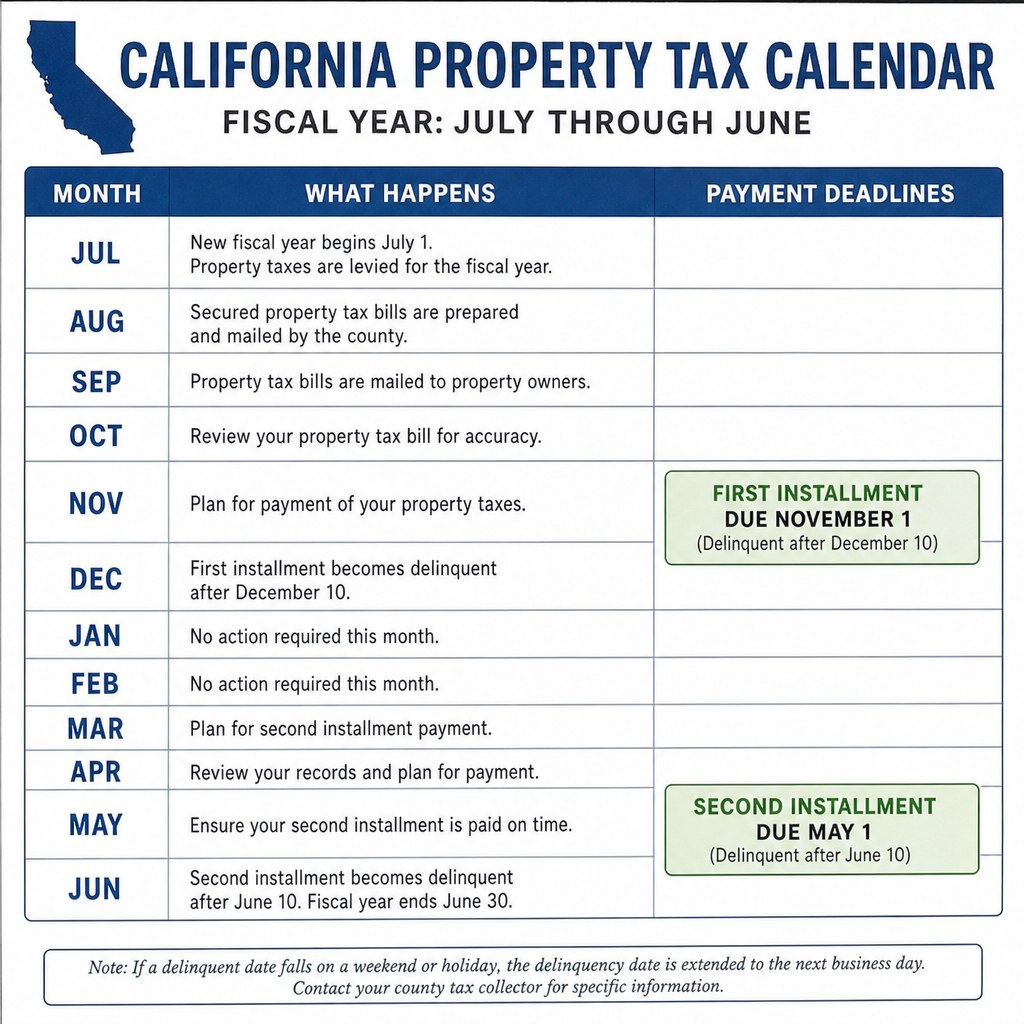
A simple way to remember the annual secured tax schedule is:
| Installment | Covers | Due date | Delinquent after |
|---|---|---|---|
| First installment | First half of the fiscal year | November 1 | December 10 |
| Second installment | Second half of the fiscal year | February 1 | April 10 |
The due date and delinquent date are not the same. You may see the bill marked due on November 1 or February 1, but penalties usually apply only if the installment is not paid or properly postmarked by the delinquency deadline. Because counties administer payments, the safest approach is to use your county tax collector’s website or office instructions rather than relying on general reminders.
The California property tax year and billing cycle
The annual secured property tax bill applies to real property such as homes and land. Counties generally mail or make annual secured tax bills available in the fall, after assessments and tax rates are applied. If you own property but do not receive a bill, you are still responsible for paying on time, so it is wise to look up your parcel online before the December and April delinquency dates.
The fiscal year structure can be confusing for new owners. A 2026-2027 property tax bill, for example, would generally relate to the fiscal year from July 1, 2026, through June 30, 2027. The first installment is due in the fall of that fiscal year, and the second installment is due the following February.
Most homeowners focus on the delinquency dates because that is when penalties begin. Still, treating the earlier due dates as planning dates is helpful. It gives you time to confirm the amount, decide whether your mortgage servicer will pay from an impound account, and resolve any mailing or parcel-number issues before the deadline.
What happens if you pay California property taxes late?
If you miss a delinquency deadline, a 10% penalty is added to the unpaid installment. For the second installment, counties also add a cost or administrative charge in addition to the 10% penalty. The exact cost charge can vary by county, so confirm the amount with the county tax collector before sending a late payment.
Late payments can be especially frustrating because the penalty is usually based on the installment amount, not on how many days late the payment is. A payment that arrives shortly after the deadline may still trigger the full 10% penalty. Postmark rules, online cutoff times, office closing hours, and payment processing rules can also matter, which is why county instructions should be followed carefully.
To reduce the risk of penalties:
- Pay through the county tax collector’s official system. Counties commonly offer online payment, mail, in-person payment, and sometimes phone or drop-box options.
- Use the parcel number shown on the bill. This helps the county apply payment to the correct property.
- Do not wait until the last minute. Online systems may have cutoff times, and mailed payments depend on proper postmarking.
- Keep confirmation records. Save receipts, confirmation numbers, canceled checks, or certified-mail records.
- Check whether your lender pays the bill. If you have an escrow or impound account, confirm whether the servicer has paid both installments.
Redemption and tax-defaulted property
When secured property taxes remain unpaid beyond the fiscal year, the property can become tax-defaulted. In practical terms, this means the unpaid taxes, penalties, and costs remain attached to the property and must be cleared through the redemption process. Redemption generally means paying the amount required by the county to bring the defaulted taxes current, including the delinquent tax, penalties, redemption penalties, and applicable fees.
The redemption process matters because unpaid property taxes are not just ordinary bills. They are tied to the property itself. If taxes remain unpaid long enough, the county tax collector may eventually gain the power to sell the property through a tax sale process, subject to required notices and statutory timelines.
For most homeowners, redemption is about resolving a delinquency before it becomes more serious. If you receive a delinquency, default, or redemption notice, contact the county tax collector promptly and ask for the exact redemption amount, deadline, and payment options. Do not assume the amount on an old bill is still accurate, because penalties and costs can change over time.
Supplemental property tax bills in California
A supplemental property tax bill is a separate bill issued when a property’s assessed value changes because of a triggering event, most commonly a change in ownership or completion of new construction. It is not a replacement for the regular annual secured tax bill. A homeowner can receive both an annual secured bill and one or more supplemental bills.
Supplemental bills often surprise buyers because they may arrive months after closing. The bill reflects the difference between the prior assessed value and the new assessed value for the portion of the fiscal year affected by the reassessment. Depending on the timing and the county’s processing cycle, a new owner may receive a supplemental bill after they have already paid the regular annual tax bill. Inherited homes can also trigger reassessment questions; see our guide to Prop 19 in California.
The due and delinquency dates for supplemental bills can differ from the annual secured tax schedule. Some supplemental bills follow the December 10 and April 10 delinquency pattern when mailed during certain months, while others use different delinquency dates based on when the bill is mailed. The key rule is simple: read the supplemental bill itself and verify the deadline with the county tax collector.
How to pay property taxes in California
Property taxes in California are paid through the county tax collector’s office for the county where the property is located. The state does not operate one single statewide payment portal for all property tax payments. Each county sets out its own payment instructions, accepted methods, convenience fees, mailing addresses, and office procedures.
Common payment methods include:
- Online payment: Many counties allow electronic checks, debit cards, or credit cards through the tax collector’s website. Card payments may include service fees.
- Mail: Payments are usually mailed with the payment stub. The postmark rule can be important, so use a reliable mailing method if paying near the deadline.
- In person: County tax collector offices may accept checks, money orders, cash, or cards depending on local policy.
- Mortgage impound or escrow account: If your lender collects monthly amounts for taxes, the lender may pay the county directly. You should still confirm payment was made.
Before paying, confirm the parcel number, installment amount, and whether you are paying a current installment, a supplemental bill, or a delinquent or redemption amount. Mixing these up can cause delays or leave a balance unpaid.
What sellers owe at closing
When a California property is sold, escrow typically prorates property taxes between the seller and buyer based on the closing date. The goal is to allocate the tax burden fairly so each party pays for the portion of the tax period during which they own the property. If the seller owned the home for part of the fiscal year, the seller is usually charged for that portion through the closing statement. For how escrow handles these items, read what is escrow in real estate and seller closing costs in California.
For example, if a sale closes partway through the fiscal year and the seller has not yet paid an installment that covers time before closing, escrow may debit the seller and credit the buyer. If the seller already paid taxes covering time after closing, escrow may credit the seller for the buyer’s share. The exact calculation depends on local escrow practice, the closing date, the tax bill status, and the purchase contract.
Property tax prorations do not always resolve every future tax issue. Supplemental taxes created by the sale may be billed after closing, and responsibility can depend on the nature of the bill and the contract terms. Buyers and sellers should review the settlement statement carefully and ask escrow, their real estate professional, or a qualified advisor to explain any tax proration line items they do not understand.
Selling soon? See what you could net after taxes and costs
Get a free home value estimate and a clear view of likely proceeds after closing costs and prorations. No obligation.
Free. No obligation to sell.
Unpaid taxes, liens, and title issues before a sale
Unpaid property taxes can create serious problems before closing because property taxes are secured by a tax lien against the property. A buyer and title insurer generally expect clear title, and delinquent taxes can prevent or delay closing until they are paid. In many transactions, escrow will use sale proceeds to pay outstanding property taxes, penalties, and costs so the lien can be cleared as part of the transfer. See selling a house with a lien in California.
Sellers should check tax status early, especially if they have missed a deadline, received a supplemental bill, inherited property, or owned the home for many years. A tax balance that seems small at first can become more complicated if prior-year taxes are in default or if a redemption amount is required. Waiting until the final days of escrow can create payoff delays and last-minute surprises on the closing statement.
A practical seller checklist includes:
- Look up the parcel with the county tax collector.
- Confirm whether both annual installments are paid.
- Check for supplemental, escaped, or corrected bills.
- Ask escrow how taxes will be prorated on the settlement statement.
- Confirm any delinquent amount, penalties, costs, and redemption charges.
- Keep written proof of payment or payoff through escrow.
Key takeaways for California homeowners and sellers
The answer to when property taxes are due in California is straightforward for annual secured bills: first installment due November 1 and delinquent after December 10; second installment due February 1 and delinquent after April 10. The property tax fiscal year runs July 1 through June 30, and if a delinquency date falls on a weekend or legal holiday, the deadline generally moves to the next business day.
Late payments trigger a 10% penalty, and additional cost charges can apply, especially after the second installment delinquency date. If taxes remain unpaid, the property can become tax-defaulted and may require redemption before the lien is cleared. Supplemental bills, escrow prorations, and unpaid tax liens are especially important in a sale, so sellers should verify amounts early and review the closing statement carefully.
Keep reading: What is escrow · Prop 19 in California · Seller closing costs · How selling with Sell For Mor works
This article is general information, not legal, tax, or financial advice. Verify exact dates and amounts with the county tax collector. Sell For Mor is powered by Rise Realty, DRE #01957687.