A trustee sale in California is the public auction that can happen at the end of a nonjudicial foreclosure. It is used when a home loan is secured by a deed of trust and the borrower does not cure the default in time. This guide explains the trustee sale definition, the timeline that usually leads to auction, what happens after the sale, and practical options a homeowner may still be able to consider.
This article is for general education only. It does not provide legal advice, financial advice, or any guarantee about your rights, deadlines, or outcome. Foreclosure timelines can turn on exact dates, loan documents, notices, bankruptcy filings, and local rules, so verify important deadlines with a qualified attorney or a HUD-approved housing counselor.
What is a trustee sale?
A trustee sale is a nonjudicial foreclosure auction conducted under a deed of trust. In California, many home loans use a deed of trust instead of a traditional mortgage; the deed of trust names a borrower, a lender or beneficiary, and a trustee. If the borrower defaults, the trustee may carry out the foreclosure process without first filing a court lawsuit, as long as the required notices and procedures are followed. California Courts describes this nonjudicial process as beginning with a Notice of Default, followed by a cure period and then a Notice of Sale before the auction. (selfhelp.courts.ca.gov)
Put another way, if you are asking what a trustee sale of property is, or what a foreclosure trustee sale is, the answer is: it is the scheduled auction where the trustee sells the real estate to satisfy the debt secured by the deed of trust. The trustee is not supposed to be acting as the homeowner’s advocate or the lender’s personal salesperson; the trustee’s role is to follow the power of sale procedure in the deed of trust and applicable California law.
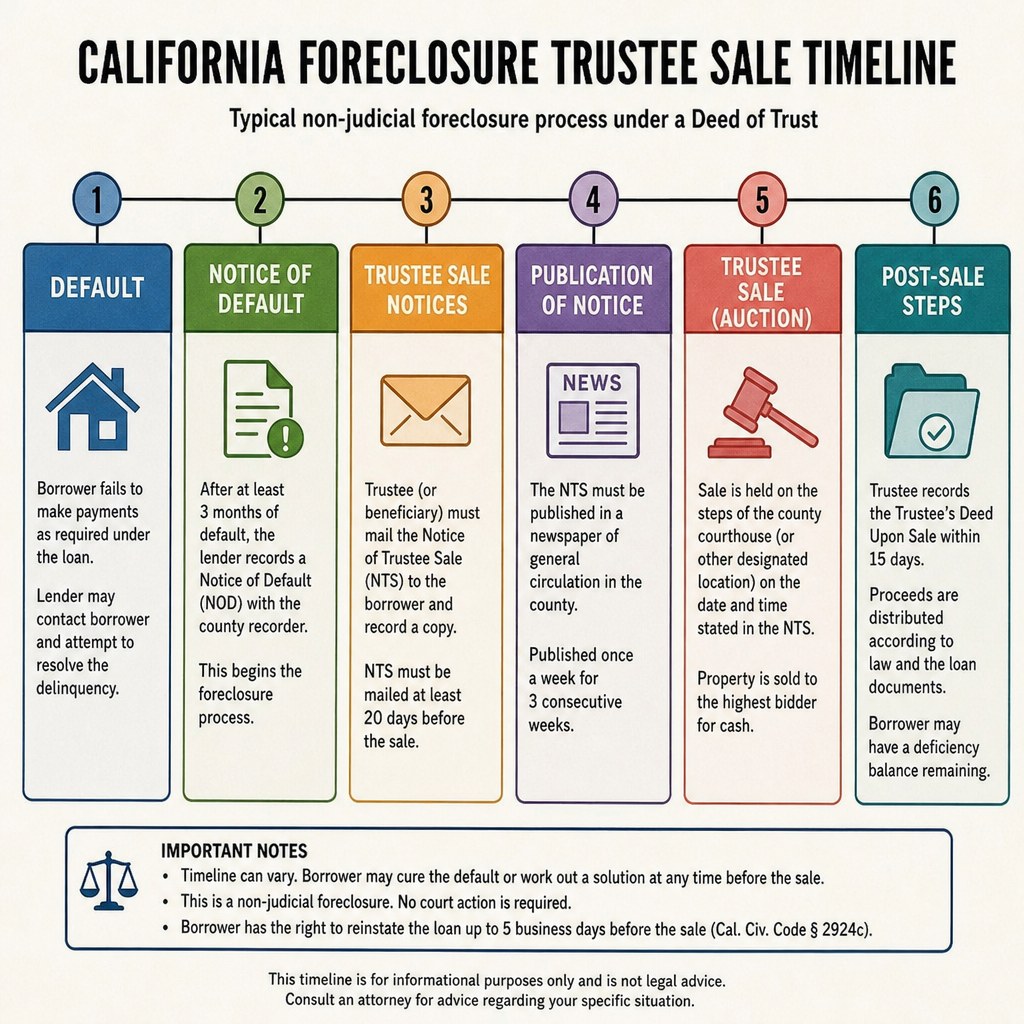
The road to a California trustee sale
A trustee sale does not normally appear out of nowhere. It follows a sequence of notices and waiting periods that are meant to give the homeowner time to understand the default, seek help, and attempt to cure the problem. Exact dates matter, so homeowners should keep every envelope, notice, reinstatement quote, and communication from the servicer or trustee. The same stages are covered from the sale-stopping angle in our guide to how to stop a foreclosure sale in California.
Notice of Default
The formal foreclosure timeline generally begins when a Notice of Default is recorded. California Courts states that the lender sends a copy of this notice by certified mail within 10 business days after recording, and the homeowner then has 90 days from the recording date to cure the default, often by paying the missed amounts and allowable fees. (selfhelp.courts.ca.gov)
This 3-month reinstatement period is one of the most important windows in the process. It is not the same as paying off the full loan. Reinstatement usually means bringing the loan current by paying the overdue installments, late charges, and permitted foreclosure costs.
Notice of Trustee Sale
If the default is not cured after the reinstatement period, the trustee may move toward auction by recording and giving a Notice of Trustee Sale. The notice identifies the property, the sale date, the time and place of sale, and trustee contact information. It is the document many homeowners mean when they ask what a notice of trustee sale is.
California Courts explains that the Notice of Sale states the trustee will sell the home at auction in 21 days. California Civil Code section 2924f requires notice of sale procedures that include posting a written notice at least 20 days before sale in a public place, publishing the notice once a week for three consecutive calendar weeks, and, where possible and not restricted, posting a copy in a conspicuous place on the property at least 20 days before the sale. (selfhelp.courts.ca.gov)
A quick timeline checklist
Use this checklist as an organizing tool, not as a substitute for legal advice:
- Notice of Default recorded: start tracking every date from the recording date.
- 3-month reinstatement period: review the amount needed to cure the default.
- Notice of Trustee Sale recorded and delivered: look for the auction date, time, place, trustee name, and instructions.
- At least 20 days before sale: required public notice, publication, and property posting rules may apply.
- 21-day sale period: the notice commonly states the trustee will sell at auction in 21 days.
- Final days before auction: verify reinstatement, postponement, bankruptcy, sale, or other options immediately with a professional.
What happens at the foreclosure auction
A trustee sale is generally a public auction. The sale may occur at the location stated in the Notice of Trustee Sale, and the trustee or auctioneer calls for bids. The lender may bid, and third-party bidders may also participate if they meet the sale requirements.
California law treats bids at a trustee sale as serious offers. The trustee may require bidders to show the ability to deposit the full final bid amount in cash, a cashier’s check, or another accepted equivalent, and the last and highest bidder is generally required to deposit the final bid amount as demanded by the trustee. (law.justia.com)
The property is awarded to the highest accepted bidder. After the sale is completed, the trustee issues a trustee’s deed upon sale to transfer title to the winning bidder, subject to legal requirements and any superior liens or rights that may still affect the property. The sale can also be postponed in some situations, so homeowners should not assume a scheduled date is final unless they verify it with the trustee, an attorney, or a HUD-approved housing counselor.
How can a homeowner stop or postpone a trustee sale?
A homeowner may have several possible ways to stop, delay, or avoid a trustee sale, but each option is deadline-sensitive. The right choice depends on the loan, equity, income, hardship, pending applications, and whether prior foreclosure events have already occurred. Get individualized advice early, because waiting until the auction week can sharply limit practical choices. See also alternatives to foreclosure in California.
Reinstating the loan
Reinstatement means paying the amount needed to bring the loan current rather than paying the entire loan balance. In California, homeowners commonly have the right to reinstate up to five business days before the scheduled trustee sale, though you should verify the exact deadline and amount in writing. Ask the servicer or trustee for a current reinstatement quote and confirm how payment must be delivered.
Paying off the loan
Payoff is different from reinstatement. A payoff means paying the full amount owed on the loan, including principal, interest, fees, and permitted costs. This may stop the foreclosure because there is no longer a secured debt to enforce, but the payoff amount must be accurate and timely.
Reviewing loan modification or loss mitigation options
A loan modification may change loan terms to make payments more manageable, but submitting documents does not automatically guarantee approval or stop every sale. Homeowners should ask the servicer what options are available, what documents are missing, and whether a complete application affects the scheduled sale. Our loan modification guide explains the process. HUD-approved counselors can help homeowners organize financial information and understand foreclosure prevention options; HUD states that foreclosure prevention counseling through approved agencies is available free of charge. (consumerfinance.gov)
Bankruptcy
Filing bankruptcy may create an automatic stay that temporarily pauses foreclosure activity. Bankruptcy is a major legal step with long-term consequences, and it must be discussed with a qualified bankruptcy attorney. Do not rely on rumors, online comments, or last-minute filing services without understanding the risks.
Selling the property before auction
A homeowner may also explore selling the property before the auction if there is enough time and equity. The sale must close before the foreclosure sale or otherwise result in a valid postponement or payoff. Homeowners should be cautious, review all documents, and avoid signing away title without professional advice. Read can I sell my house in foreclosure in California.
Facing a sale date and weighing a sale of your home?
Get a free, no-pressure estimate of your home value so you can compare selling against your other options. No obligation.
Free. No obligation to sell.
After the trustee sale: possession, eviction, and tenants
Once a trustee sale is completed, the former homeowner generally no longer owns the property. That does not mean the new owner can simply change the locks or remove people without process. California Courts explains that if the former homeowner does not move out, the new owner must serve a 3-day written notice to quit and then go through the formal court eviction process if the person remains. (selfhelp.courts.ca.gov)
Tenants can have different rights than former owners. California Courts explains that tenants in a foreclosed property may be entitled to at least 90 days’ notice, and some fixed-term leases or local protections may affect how long a tenant can remain. The new owner must generally use the court eviction process to obtain an order changing possession. (selfhelp.courts.ca.gov)
For homeowners, the practical takeaway is to plan early. If the sale has occurred, gather the trustee’s deed information, any notice to quit, lease documents if tenants live there, and any communications from the new owner. Then speak with an attorney, legal aid office, or HUD-approved counselor about next steps.
Surplus proceeds after a trustee sale
Surplus proceeds are funds left over after the trustee sale proceeds are used to pay the foreclosure costs, the foreclosing debt, and other claims in the required order. If the winning bid is higher than the total amounts that must be paid, there may be excess money available to junior lienholders or, in some cases, to the former homeowner. California Civil Code section 2924k addresses the order in which trustee sale proceeds are distributed. (law.justia.com)
If you believe there are surplus proceeds, contact the trustee in writing and ask for the surplus claim process, required forms, and deadlines. Do not ignore mail from the trustee or court. If there are competing claims, the funds may be handled through a court process, and the former homeowner may need legal help to protect a claim.
Scam warnings for homeowners facing trustee sales
Trustee sale pressure creates a perfect opening for scams. Be especially cautious if someone guarantees they can stop the sale, demands upfront fees for foreclosure rescue, tells you not to contact your lender, pressures you to transfer title, or asks you to sign documents you do not understand. California real estate regulators warn that foreclosure rescue scams often target financially distressed homeowners with promises to save the property in exchange for fees or title transfers. (dre.ca.gov)
Before signing anything, verify licenses where applicable, read every document, and get independent advice from an attorney or HUD-approved housing counselor. HUD advises homeowners to understand their mortgage rights, learn state foreclosure timeframes, and contact a HUD-approved housing counselor for help with options and negotiations. (hud.gov)
Key takeaways for California homeowners
A trustee sale in real estate is not just a notice or a threat; it is the auction stage of a nonjudicial foreclosure under a deed of trust. The process usually includes a Notice of Default, a 3-month cure period, a Notice of Trustee Sale, required publication and posting, and then a public auction where qualified bidders use a cashier’s check or accepted funds and the highest bidder receives a trustee’s deed.
If you are facing a sale date, act quickly but carefully. Confirm deadlines, request written payoff or reinstatement figures, explore legitimate loss mitigation, consider whether bankruptcy or a pre-auction sale is appropriate, and watch for surplus proceeds if the sale goes forward. Most importantly, verify all foreclosure-related deadlines with a qualified attorney or HUD-approved housing counselor, because this guide provides information only and cannot guarantee what will happen in your specific situation.
Keep reading: How to stop a foreclosure sale · Selling a house in foreclosure · Mortgage grace period · How selling with Sell For Mor works
This article is general information, not legal advice. Foreclosure deadlines are strict; verify them with an attorney or HUD-approved counselor. Sell For Mor is powered by Rise Realty, DRE #01957687.