If you are asking how much do real estate agents make in California, the most useful answer is a range, not a single paycheck. In 2026, the latest statewide wage benchmark shows California real estate sales agents at a $57,560 median annual wage, while brokers are higher at $80,450. Actual take-home income can be much lower or much higher because many agents earn by commission, split that commission with a broker, and pay their own business expenses.
How much do real estate agents make in California?
Real estate agents in California make a median of about $57,560 per year based on the latest 2025 wage data available in 2026. The same data shows the lower 10% at $40,150 or less and the upper 10% at $111,320 or more, which is why searches like “how much does a real estate agent make in California” can return very different answers depending on whether the source is using median wages, average commissions, job postings, or self-reported income. (onetonline.org)
That median is a helpful baseline for real estate salary California research, but it does not mean every agent receives a predictable salary. The Bureau of Labor Statistics notes that real estate brokers and sales agents earn most of their income from commissions, that commissions may be divided among agents, brokers, and firms, and that earnings can be irregular, especially for beginners. (bls.gov)
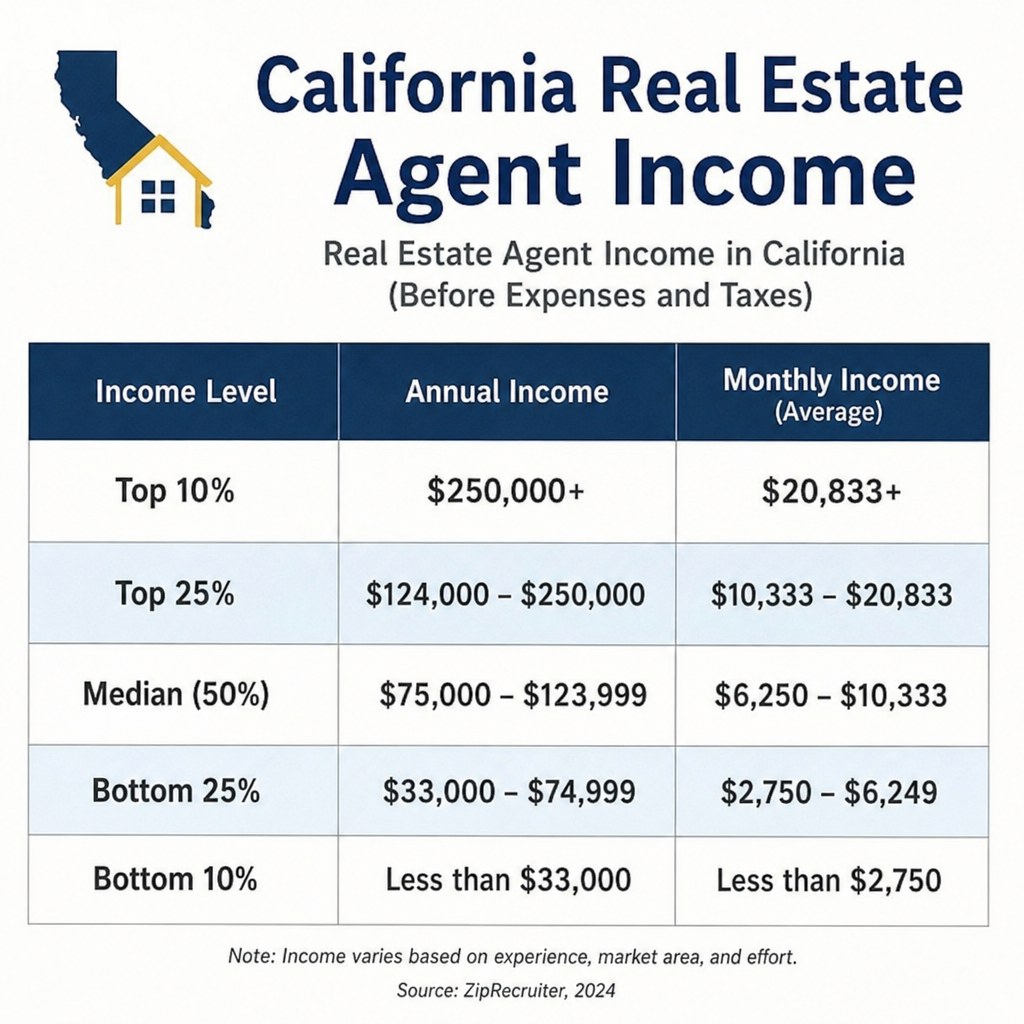
The 2026 California real estate income snapshot
Here is the clearest current picture for real estate agent salary California and real estate broker salary California comparisons:
| Role | California median annual wage ($) | 10th percentile ($) | 90th percentile ($) | What it suggests |
|---|---|---|---|---|
| Real estate sales agent | 57,560 | 40,150 | 111,320 | Common benchmark for agent earnings |
| Real estate broker | 80,450 | 37,120 | 145,660 | Higher median, broader responsibilities |
| U.S. sales agent median | 52,830 | 32,970 | 123,590 | California is above the national median |
| U.S. broker median | 73,220 | 37,110 | 143,300 | California brokers are also above the U.S. median |
Sales agent wage figures come from O*NET’s California wage table using BLS 2025 data, and broker figures come from O*NET’s California broker wage table using the same source. (onetonline.org)
The key takeaway: the median real estate agent income California figure is respectable, but the spread is wide. A newer agent working part time may earn less than the median. A productive full-time agent in a strong niche, with steady referrals and disciplined expenses, can exceed it.
Why does real estate agent income vary so much?
Real estate agent income varies because the job behaves more like a small business than a traditional salaried role. Agents must generate leads, convert clients, navigate changing market conditions, close transactions, and manage expenses before they know their real take-home income.
A typical commission-based income path depends on several moving parts:
- Transaction volume: More closed deals usually means more gross commission income, but only if the agent is profitable.
- Home prices: California’s expensive markets can create larger commission opportunities, but competition and client expectations are also high.
- Commission agreement: Broker fees and commissions are negotiable and not set by law; written agreements may define compensation before services begin. (nar.realtor) See real estate commission in California.
- Broker split: A sales agent must work under a broker, and the agent’s share depends on the brokerage model and agreement.
- Expenses: Marketing, licensing, association dues, MLS access, transportation, signs, photography, software, and taxes can reduce net income.
- Seasonality and timing: One closing can make a month look strong, while a slow quarter can create cash-flow stress.
This is why “how much do real estate agents make in CA” is really two questions: what do agents gross, and what do they keep? Transaction counts matter too; see how many houses the average Realtor sells per month.
A simple commission example
Imagine an agent represents one side of an $800,000 home sale. If the agreed compensation for that side is 2.5%, the gross commission for that side would be $20,000. If the agent keeps 70% after the brokerage split, the agent’s gross before business expenses and taxes would be $14,000.
That example is not a promise or a standard rate. It simply shows the math. The final amount depends on the written agreement, any broker-to-broker or client-paid compensation arrangement, brokerage split, transaction fees, and the agent’s operating costs. In 2026, agents should be especially comfortable explaining compensation clearly because buyers and sellers are more aware that commissions are negotiable.
Realtor salary California vs. real estate agent salary
Many people search for realtor salary California or ask how much do Realtors make in California when they mean real estate agents generally. Technically, REALTOR® is a membership mark for real estate professionals who are members of the National Association of REALTORS®, not a generic label for every licensed agent. (nar.realtor) We explain the difference in broker vs. agent vs. Realtor.
In practical salary research, however, many consumer-facing sources use “Realtor” and “agent” interchangeably. The income mechanics are usually similar: a licensed professional earns through transactions, pays business expenses, and may split compensation with a broker. If you are comparing opportunities, focus less on the label and more on license type, brokerage support, lead sources, market, niche, and net income after costs.
California markets do not pay agents the same
Statewide numbers hide major local differences. O*NET’s California sales agent wage table shows San Jose-Sunnyvale-Santa Clara at a $96,170 median annual wage, San Francisco-Oakland-Fremont at $70,990, San Diego-Chula Vista-Carlsbad at $62,680, Sacramento-Roseville-Folsom at $59,520, and Los Angeles-Long Beach-Anaheim at $47,020. (onetonline.org)
Those differences do not automatically mean one market is “better.” A higher-priced area may offer bigger transactions, but it may also come with more competition, higher marketing costs, longer client decision cycles, and a higher personal cost of living. A lower-median market may still be excellent for an agent with strong relationships, a clear niche, and lower operating expenses.
Brokers usually earn more, but they also carry more responsibility
California brokers have a higher median wage than sales agents, with the latest O*NET/BLS-based data showing a $80,450 median annual wage for real estate brokers in the state. Brokers may run offices, supervise sales agents, handle compliance, manage transactions, or operate independently, depending on their business model. (onetonline.org)
The licensing path is also more demanding. The California Department of Real Estate says broker applicants generally need either qualifying experience, such as two years of full-time licensed salesperson experience within the last five years, equivalent experience, or a qualifying real-estate-focused four-year degree path, along with required coursework and exam approval. (dre.ca.gov)
For many agents, becoming a broker is not just a “raise.” It is a shift into ownership, supervision, risk management, recruiting, training, or higher-level client work.
The California agent population is competitive
California remains a large and competitive licensing environment. The Department of Real Estate reported 291,609 salespersons, 116,784 brokers, and 408,393 total licensees in June 2026, down from the same month a year earlier. (dre.ca.gov)
That matters because the number of licensed people is far larger than the number of agents who close consistent business. Many licensees are part time, inactive, referral-only, or in related roles. For a new agent, the opportunity is real, but so is the need to stand out quickly.
Practical ways to increase real estate agent income in California
Raising income is rarely about one trick. It usually comes from improving the whole business system:
- Pick a specific market lane. First-time buyers, probate, relocation, luxury listings, investors, leases, or a single neighborhood are easier to market than “I help everyone.”
- Track lead sources. Know which activities create appointments, signed agreements, offers, and closings.
- Build a referral engine. Past clients, local professionals, community groups, and content can produce warmer leads than cold prospecting alone.
- Improve listing skills. Pricing strategy, preparation advice, marketing, and negotiation can create repeatable value for sellers.
- Control expenses. A high gross commission year can still disappoint if advertising, desk fees, tools, and taxes are unmanaged.
- Learn the numbers. Agents who understand affordability, financing, local inventory, and negotiation terms can advise clients more confidently.
Is becoming a California real estate agent worth it in 2026?
It can be worth it if you treat it as a commission-based business and have enough financial runway to handle irregular income. The BLS notes that the real estate market is sensitive to economic conditions and interest rates, and that income can be uneven for brokers and agents. (bls.gov)
The upside is flexibility, local market expertise, and income potential that can grow with skill and consistency. The risk is that licensing alone does not create clients. Before entering the field, estimate your startup costs, choose a brokerage carefully, ask about training and lead support, and build a six- to twelve-month plan for prospecting, savings, and accountability.
Bottom line
The best current answer to how much do real estate agents make in California is this: the median sales agent earns about $57,560, while the median broker earns about $80,450, but real income depends heavily on closings, commission agreements, broker splits, expenses, and market focus. If you are comparing real estate careers, look beyond the headline salary and calculate realistic net income.
California can reward skilled, consistent agents, but it is not automatic. The agents most likely to build strong income are the ones who treat the license as the starting point—and the business plan as the real job. If you are a homeowner choosing who to hire, see questions to ask a Realtor when selling and why use a Realtor.
Selling a California Home?
Sell For Mor is a listing team: four specialists handle marketing, pricing, selling, and negotiating your sale. Start with a free home valuation, then see how Sell For Mor works.
Free. No obligation to sell.
Keep reading: how to choose a listing agent and home selling timeline.
This article is general information, not financial or career advice. Wage figures are published benchmarks and individual earnings vary. Sell For Mor is powered by Rise Realty, DRE #01957687.